Past Events
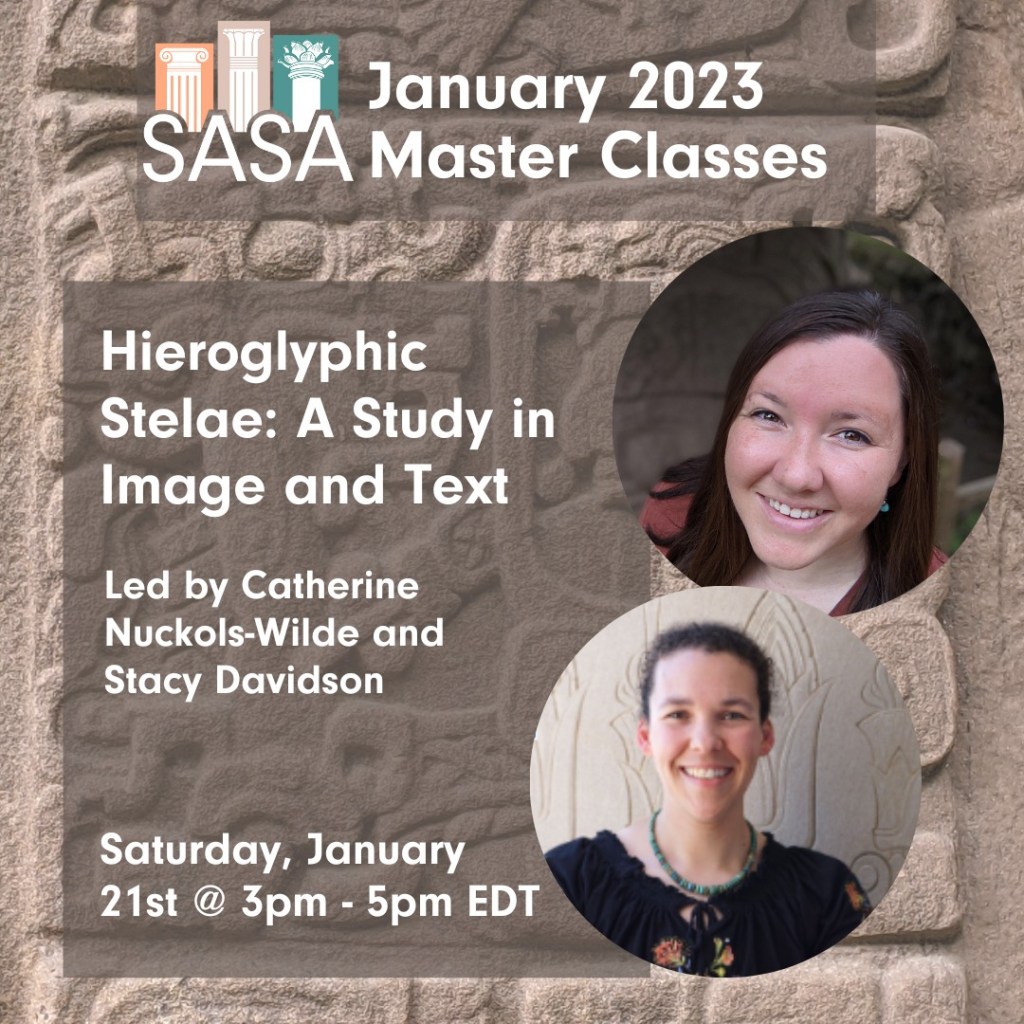
21 Jan 2023: “Hieroglyphic Stelae: A Study in Image and Text,” a SASA Master Class with Mayanist Catherine Nuckols-Wilde
Both the Maya and the ancient Egyptians created and displayed the object type we call a stela (a sizable slab of stone with images and writing) for different purposes, including: to record major events and provide for the dead in the Afterlife. You can see stelae (the plural of stela) in museums around the world today. When they are displayed in museums, particularly in art museums, the focus is on the striking visuals of these objects—less so on the valuable cultural information their inscriptions contain. If you have ever been curious about the pictographic writing of the Egyptians and the Maya, want to understand basic linguistic information about the two hieroglyphic writing systems, and would like to study cultural information that will bring ancient Egyptians and Maya people to life, this Master Class is for you. Both Catherine Nuckols-Wilde (Mayanist) and Stacy Davidson (Egyptologist) will give a brief overview of the stela form and how they were used similarly and differently in the two respective cultures they study. They will then provide basic hieroglyphic language instruction that you can apply the next time you see a Maya or Egyptian stela in a museum or look at a museum’s catalog online. The Master Class will end with a practical application of your newly-acquired hieroglyphic and cultural knowledge when you design your own ancient Egyptian stela and choose which information you would include on a Maya stela.
7 Dec 2022: In-Person Talk at Shawnee Town 1929, 11600 Johnson Drive, Shawnee, KS 66203
https://www.facebook.com/ShawneeTown1929/videos/857710965370937 Video available via Facebook

“Since the first steps of King Tutankhamun’s tomb were uncovered in November 1922, the world has been obsessed by the life and possessions of the Boy King. The wave of Egyptomania that hit the US in the 1920s ushered in another Egyptian Revival, sometimes called “Tutmania,” that influenced art, architecture, fashion, and design as well as enhanced our understanding of ancient Egypt. Join Egyptologist Stacy Davidson on a journey through the life and times of King Tutankhamun, the excavation of his tomb, and the enduring legacy of his impact on our arts and pop culture. Tickets for the program are $5.00 and includes a complimentary beverage from our evening’s featured brewery! Visitors will also get the chance to tour 1920’s automobiles, displayed courtesy of our friends at the Plain Ole A’s Model A Ford Club.”
About the Speaker: Egyptologist Stacy Davidson teaches credit and non-credit courses at Johnson County Community College where she has developed and taught over 30 distinct courses on Egyptology and the Ancient World. She is the 2021 Adjunct Faculty Lieberman Teaching Excellence Award winner as well as a JCCC College Scholar for her work on Dark Egypt: Negative Connotations of Egypt in 19th Century American Thought. She is the co-founder and first President of the Missouri Chapter of the American Research Center in Egypt (ARCE-MO) and the founder and Team Lead of the Egyptology State of the Field Project which is the first demographic, educational, and occupational study of Egyptologists in the United States. She is currently conducting research for a 2020-2021 Mellon/ACLS Community College Faculty Fellowship project titled “We are for Egypt” which illuminates the history, culture, and distinct identity of the region of Illinois known as “Egypt” or “Little Egypt.”
19 Nov 2022: Panel Co-Chair and Presenter, ASOR Annual Meeting
Workshop Co-Chair: Fostering Dialogue Using Educational and Occupational Datasets
Presenter: The Egyptology State of the Field Project: From Idea to Implementation
Trends in higher education coupled with societal changes have prompted a phase of introspection into the nature of academic fields, their role in historical and current injustices, and sustainability. Many fields, spearheaded by professional organizations, have been collecting pertinent data and using that data to revise curricula, mentorship, and professional development opportunities over the past few decades. However, within Egyptology, the answers to even the most basic of these questions are non-existent.
The Egyptology State of the Field project (www.egyptologystats.org) was established by a team of volunteers in 2020 to confront this lack of data. The project’s primary goal is to create a baseline understanding of the field of Egyptology and its participants in the United States. The first stage of the project collected both survey and interview data. Our analysis of the data will identify: (1) the demographics of the field of Egyptology and the inequities faced by historically marginalized populations; (2) roadblocks for graduate students and early career scholars on the Egyptological job market; and (3) experiences with accessibility, professional development, and completion/retention for graduate students and early career scholars. The data collected will provide crucial information to potential and current Egyptology students, Egyptology programs, job seekers, and those currently in Egyptology and Egyptology-adjacent professions. This paper provides an introduction to the project, its formation, team members, goals, and methodologies of data collection.
4-5 Nov 2022: Recovering the Vampire Online Conference

Registration link (closes 24 Oct 2022) and full program details= https://recoveringthevampire.wordpress.com/programme/
Title: From the “Dark Gift” to the “Great Family”: Ancient Egyptian Death and Rebirth in Anne Rice’s The Queen of the Damned
Abstract: The Queen of the Damned, the third installment in Anne Rice’s The Vampire Chronicles, draws explicitly upon death and rebirth imagery, themes, and concepts from ancient Egypt (Kemet) as recorded in religious writings such as the myths of Osiris and Isis, Sekhmet’s attempt to destroy mankind, and the Contendings of Horus and Seth. By placing the origins of the vampire into this milieu, Rice situates her preternatural cosmogony into a long tradition of the reception of ancient Egypt in literature and the arts while, at the same time, imbuing her tale with cultural gravitas. One of the strengths of Rice’s vampiric character development is that her creations are not static or underdeveloped, and, by implying or explicitly stating these Egyptian connections in her narrative arc of The Story of the Twins, she superimposes her vampire origin story onto the framework of ancient mythology. On the one hand, there is the violent and powerful Queen Akasha, the first vampire, whose selfish and simplistic tendencies threaten humans and vampires alike. On the other, Maharet, one of the Twins, rises from the traumas and tortures she suffered through Akasha’s will, and emerges from her vampiric birth still retaining ties to humanity and her mission to foster community between vampires and humans and also amongst vampires themselves. It is through Maharet’s motivations, feelings, actions, and responses to trauma that qualities such as tolerance, compassion, devotion to family, and strength in community can be explored. This paper establishes a foundation for understanding Rice’s origins of the vampire in its ancient Egyptian context and juxtaposes the two powerful female figures of Akasha, with her allusions to the destructive goddess Sekhmet, and Maharet who embodies the qualities of the goddess Isis with her focus on wholeness, family, and protection.
22-23 Oct 2022: “Onwards and Upwards: 200 Years of Egyptomania”, The International Society for the Study of Egyptomania (ISSE) Online Conference
To register or view the abstract/presenter bios click here.
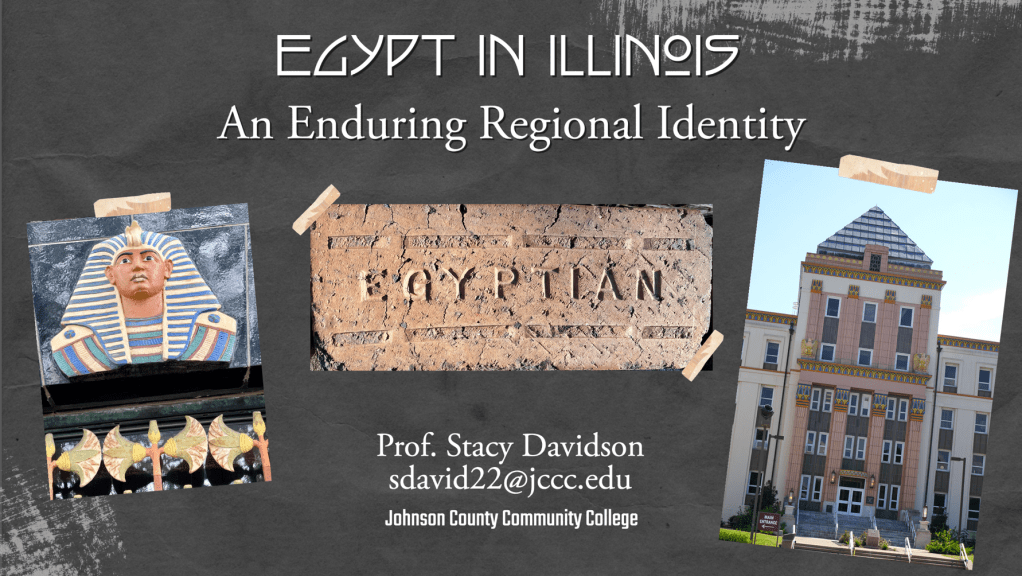
Title: Egypt in Illinois: An Enduring Regional Identity
Date and Time: Sunday, 23 Oct 2022, 6:25am US Central Time (Day 2)
Abstract: The southern tip of the U.S. state of Illinois has been known as “Egypt” and “Little Egypt” for nearly 200 years. Town names such as Cairo, Karnak, and Thebes dot the landscape. While visual vestiges of this Egyptian regional identity can be seen in cemeteries, architectural elements, monuments, and business names to this day, the complex histories of this association have been obscured by time. Initially, the regional identity developed as part of a larger narrative that attempted to link “new” American territories with a mythic past: the Mississippi River was compared to the Nile, and the earthen mounds at the site of Cahokia were likened to pyramids. Cultural and religious thought also connected this American Egypt with the abundance and prosperity of “going to Egypt for grain” as mentioned in Genesis 42. By the mid-19th century, however, the residents of Egypt (ILL) were increasingly accused of embodying a moral “darkness” due to strong Southern sympathies. Although Illinois remained a Northern state, a faction in Southern Illinois wanted to break away from the Union and join the Confederacy, creating the state of “Egypt.” After the U.S. Civil War, Egyptian Illinoisans became concerned with improving their reputation by looking back to their regional origins as well as focusing on ethnographic studies of music, folklore, and dialect. This paper traces the origins, evolution, and lasting legacy of Egypt, Illinois, and places it within a greater historical narrative of the reception of Egypt in the 19th and 20th centuries.
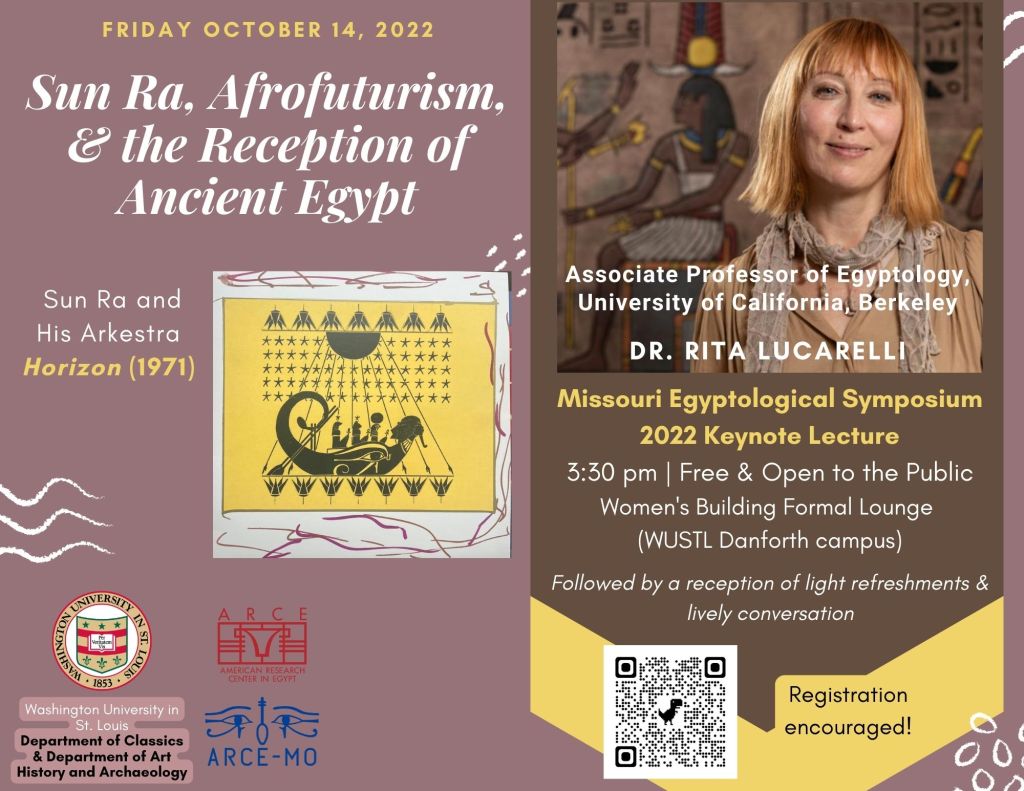
14-15 Oct 2022: #MOEgypt4 at Washington University, St. Louis

Title: “We Are For Egypt”: Using a Public History Project to Catalyze a Community
Abstract: It is increasingly apparent that historians must make a concerted effort to demystify the process of “doing history” as well as provide avenues for interested learners from a wide array of backgrounds to obtain valuable historical information. To this end, the project, “We Are For Egypt: The History, Culture, and Legacy of Egyptian Southern Illinois,” was developed. Backed by a Mellon/ACLS Community College Faculty Fellowship, the project consists of two components designed with community outreach in mind. First, an Educator’s Handbook collates geographic and historical information from the portion of Illinois known as “Egypt” or “Little Egypt” along with ancient Egyptian material—allowing residents to contextualize Southern Illinois’ Egyptian identity. Secondly, a musical album provides a platform for multi-genre musicians from Southern Illinois to showcase the region’s musical heritage. The album consists of five traditional songs as well as five newly-commissioned songs that express what “Egypt, Illinois” means to them today. In this paper, I elucidate the manifold goals of this project: encouraging community engagement in local history and arts, showcasing the creative and artistic talent of the region, increasing awareness of “Egypt, Illinois” among the Egyptological community, offering pertinent Egyptological resources to the residents of Southern Illinois, stimulating the local economy, and modeling an avenue for scholars to utilize a traditional funding source, a national non-profit grant, in a way beneficial to public history and an underserved community.

12 Oct 2022: SASA’s “Crewing the Ship” Port Ancient Livestream
“Join us for a chat with The Egyptology State of the Field team members Stacy Davidson, Julia Troche and Jessica Johnson to learn more about their important work. The Egyptology State of the Field is an independent, collaborative, international project staffed by volunteers with educational and professional backgrounds in Egyptology and Egyptology-adjacent fields. Establishing a field-wide study of Egyptology and its practitioners with the goal of gathering demographic, educational, and occupational data has never been undertaken in the United States and thanks to this team the first stages of the project are underway and consisted of a short, anonymous online survey with the option for an extended interview. We’ll talk about this project and more!”
Two of my recent projects were highlighted at the ARCE 2022 Annual Meeting in April:
Quantifying Representation and Disadvantage in Egyptology: Results of the Egyptology State of the Field Project by Dr. Anne Austin= https://vimeo.com/713529732
Teaching Ancient Egypt in Museums: Creating a Space for Inspiration and Collaboration by Dr. Lisa S. Haney= https://vimeo.com/705875393
Join me for a special Archaeology Month event on Saturday, 23 Oct 2021, starting at 7pm Central. It will be a hybrid showing of “The Mummy” (1932) with Boris Karloff followed by a presentation on the themes in the movie as they relate to Egyptology and the reception of ancient Egypt in a gothic/horror setting. The event is free and open to the public. RSVP: saraasher@seaburyacademy.org for a Zoom link or attend in person at Bishop Seabury Academy Commons at 4120 Clinton Parkway, Lawrence, KS.

Save Ancient Studies Alliance and Digital Hammurabi Present: Opening the Ancient World, a virtual conference, 15-16 Aug 2021

The Egyptology State of the Field Project: A Data-driven Assessment of American Egyptology
Presented by Stacy Davidson and Dr. Anne Austin
Trends in higher education along with societal changes have required scholars to evaluate the nature of their fields, confront historical and current injustices, and determine whether or not their disciplines can survive into the future. Many fields have been collecting pertinent data and revising curricula and methodologies over the past few decades. However, within Egyptology, the answers to even the most basic questions remain unknown: How many Egyptologists are there in the United States? What barriers do historically marginalized groups experience, and how do we overcome those to create a more inclusive and diverse discipline? What can be done to improve job prospects for recent graduates and contingent faculty?
The Egyptology State of the Field project was established in 2020 to address this lack of data. The first stage of the project collected both survey and interview data from U.S. citizens as well as those who were trained or work in the United States. Our analysis of the data will identify and address: (1) the demographics of the field of Egyptology and the inequities faced by underrepresented populations; (2) roadblocks for graduate students and early career scholars on the Egyptological job market; and (3) experiences with accessibility, professional development, and completion/retention for graduate students and early career scholars. The data collected will provide crucial information to potential and current Egyptology students, Egyptology programs, job seekers, and those currently in Egyptology and Egyptology-adjacent professions.
Please note, the conference will be free and publicly live-streamed at saveancientstudies.org/virtual-conference, as well as on SASA’s and Digital Hammurabi’s social media platforms, with questions open to the public via text chat. The two Roundtable sessions will be live-streamed, though only participants in the Zoom meeting will be able to engage in the discussion; therefore, pre-registration to the Roundtables is necessary to participate.
Do Ancient Egyptians Dream of Electric Sheep: The Reception of Ancient Egypt in Science Fiction
9-10 July 2021
Virtual Conference
Free and open to the public
“Luminous beings are we”: Force Ghosts and akhu
Presenters: Stacy Davidson and Julia Troche
Description: What can we learn about ancient Egyptian akhu through an analysis of Force Ghosts from Star Wars? In this paper, we argue that popular culture and manufactured, real or imagined, realities can help students and researchers explore remote, ancient concepts and practices. From a pedagogical perspective, Science Fiction universes are often more relatable, accessible, and rounded than our ancient archaeological and textual records. They further promote creative and innovative approaches that expand the types of questions and methodologies used to explore ancient concepts. To make this point, we consider as a case study the akhu (ancient Egyptian “effective dead” spirits) in tandem with Star Wars Force Ghosts (manifestations of the essence of deceased Force-sensitives).
In our analysis, we focus on evidence for akhu dating primarily to the New Kingdom (e.g. letters to the dead and akh iqr n Ra stelae) as well as Force Ghosts from Episodes IV-VI, The Clone Wars, and Rebels animated series. We investigate the processes by which the dead become Force Ghosts and akhu respectively and the modes of communication employed by these supernatural entities. Further, we offer novel lines of inquiry that confirm the effectiveness of this exercise.
You can watch our participation in the “Egypt on the Big Screen” panel at time stamp 03:47:00-04:07:05 below:

ARCE-MO Events
During the pandemic, ARCE-MO’s virtual lectures are free and open to ARCE members and the general public. Visit ARCE-MO’s website or like/follow ARCE-MO on Facebook and Twitter to receive notifications.
JCCC Ed Talks on Egyptian themes can be viewed via YouTube:
Get in Touch
Send Us a Message
Thank you for your response. ✨

 Scribe's Palette