
The Egyptology State of the Field Project
The Egyptology State of the Field project team came together in 2020 to ascertain the state of the field of Egyptology in the United States. To date, there has been no formal quantitative (demographic) or qualitative assessment of the individuals who make up this field. In recent years, several other fields have carried out projects of this sort and the data generated therefrom have been quite beneficial in terms of providing a base statistic for the creation of new scholarships, grants, and programs to better address both recent changes and longstanding issues in their constantly-developing disciplines.
We hope that the results of this study will be used to identify specific needs in the field of Egyptology, including but not limited to improving diversity, supporting student experiences, exploring professional networks outside the field, normalizing non-tenure track employment, and so forth. These data will benefit professionals in the field as well as those hoping to enter Egyptology and will also be beneficial to those who have left the field and pursued other opportunities.
This project is not sponsored by or affiliated with any Egyptological organization or program. To learn more about the project and its team members and receive updates about our progress, please visit our website and like/follow us on Facebook, or Twitter.

Photo by S. Davidson
Egypt, Illinois
The southern third of the state of Illinois has had an affiliation with ancient Egypt that they have drawn upon for nearly two centuries; this is reflected in the moniker for the region, “Egypt” or “Little Egypt,” in addition to the establishment of cities and towns with names like Cairo, Karnak, Thebes, and Lake of Egypt. The precise date and reason for adopting an affiliation with the civilization of the ancient Egyptians is shrouded in folklore and legend. Preliminary pre-publication research brings together contemporary newspaper accounts, Egyptological knowledge, and regional history in an interdisciplinary treatment of an overlooked topic in American History.
A portion of this work was featured as part of the 2020-2021 JCCC College Scholar series:
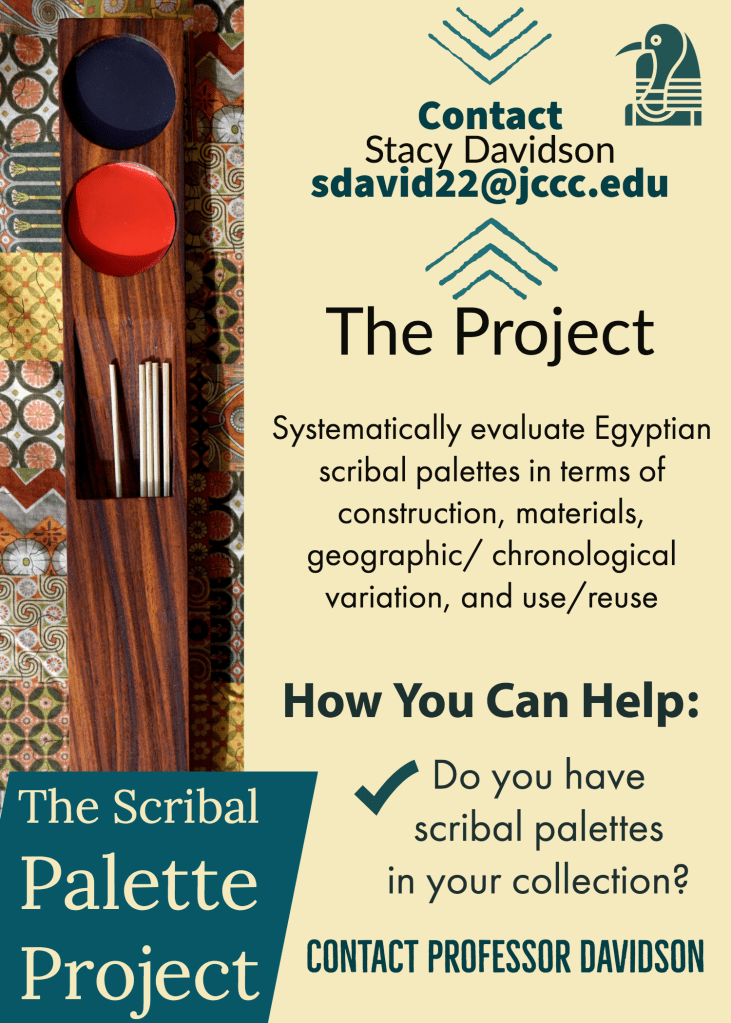
 Scribe's Palette